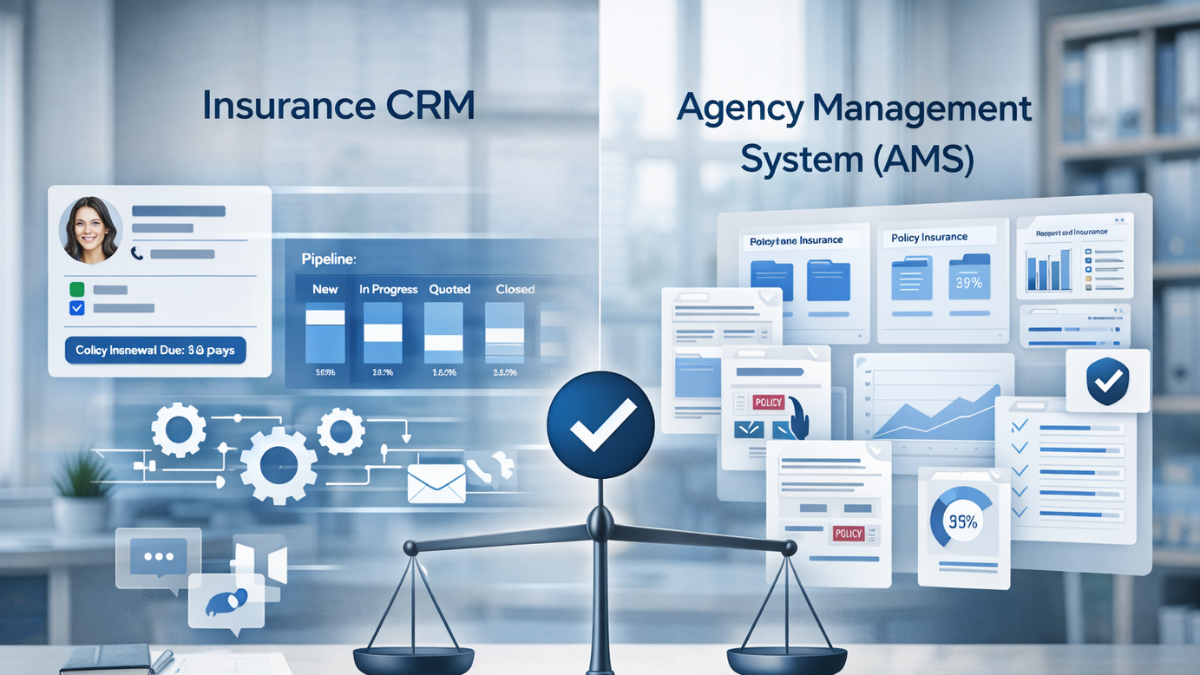
The insurance industry in the United States is evolving rapidly, driven by digital transformation and rising customer expectations. Insurance professionals today are under constant pressure to respond faster, manage more data, and deliver a personalized experience. As agencies grow, many owners and agents face an important technology decision: Should you choose an Insurance CRM or an Agency Management System (AMS)?
While both tools are designed to improve efficiency, they serve different purposes. Understanding the difference between an insurance CRM and an AMS is essential before investing in either solution. In this in-depth guide, we will explain how both systems work, their key differences, advantages, limitations, and which option makes the most sense for your insurance business.
Understanding Insurance CRM
An Insurance CRM (Customer Relationship Management system) is primarily designed to manage relationships with leads, prospects, and clients. Its main focus is on sales, communication, and customer engagement. Insurance CRMs help agents track interactions, automate follow-ups, and nurture leads through the sales funnel.
For insurance agents, a CRM acts as a centralized hub where client contact details, communication history, quotes, and policy-related notes are stored. This allows agents to maintain consistent and professional communication across email, phone calls, and SMS. Over time, a CRM becomes a powerful tool for increasing conversions and improving customer retention.
Insurance CRMs are especially popular among independent agents, small agencies, and sales-focused teams because they are flexible, scalable, and relatively easy to implement.
Understanding Agency Management System (AMS)
An Agency Management System, commonly known as AMS, is a more operational and administrative platform. Unlike a CRM, an AMS is designed to manage the entire back-office workflow of an insurance agency. This includes policy administration, carrier integration, accounting, claims tracking, and compliance documentation.
AMS platforms are typically used by established insurance agencies that handle a large volume of policies across multiple carriers. These systems focus less on sales automation and more on record-keeping, reporting, and regulatory compliance. An AMS becomes the system of record for the agency, storing detailed policy and transaction data.
Because of their complexity, AMS platforms often require onboarding, training, and higher implementation costs. However, for agencies with complex operations, they provide long-term stability and control.
Core Difference Between Insurance CRM and AMS
The fundamental difference between an insurance CRM and an AMS lies in their purpose. A CRM is client and sales-focused, while an AMS is policy and operations-focused. A CRM helps you win and retain customers, whereas an AMS helps you manage the business after the sale is complete.
Insurance CRMs are designed to help agents close more deals, follow up faster, and build stronger relationships. AMS platforms, on the other hand, are built to ensure policies are processed correctly, commissions are tracked, and regulatory requirements are met.
Many insurance professionals mistakenly assume that one system can replace the other. In reality, they often complement each other, especially in larger agencies.
Features of an Insurance CRM
An insurance CRM excels at lead management and communication. It captures leads from websites, landing pages, referrals, and marketing campaigns, then organizes them automatically. Agents can see where each lead stands in the sales pipeline and prioritize follow-ups accordingly.
Automation is one of the strongest advantages of a CRM. Follow-up emails, SMS reminders, appointment scheduling, and renewal notifications can all run automatically. This ensures no opportunity is missed and every prospect receives timely communication.
Insurance CRMs also provide sales analytics that help agents understand which lead sources convert best and which agents perform at the highest level. This insight allows agencies to optimize their sales strategy and marketing spend.
Features of an Agency Management System (AMS)
An AMS focuses heavily on policy lifecycle management. It tracks policies from issuance to renewal, including endorsements, cancellations, and claims. Many AMS platforms integrate directly with insurance carriers, allowing agencies to download policy data and reduce manual entry.
Another major strength of AMS software is accounting and commission tracking. Agencies can monitor carrier commissions, producer splits, and financial performance in one place. This is particularly valuable for agencies with multiple agents and complex compensation structures.
Compliance and documentation are also core features of AMS platforms. Insurance agencies in the United States operate under strict regulatory requirements, and AMS systems help ensure accurate record-keeping and audit readiness.
Which System Is Better for Sales Growth?
When it comes to sales growth, insurance CRMs clearly have the advantage. CRMs are designed to improve response time, automate nurturing, and personalize communication. These capabilities directly impact lead conversion and customer retention.
An AMS, while powerful for operations, is not optimized for sales automation or marketing campaigns. It may store client information, but it does not actively help agents close deals faster or engage prospects more effectively.
For agencies focused on growth, especially those investing in digital marketing, a CRM is often the first and most important tool to implement.
Which System Is Better for Operations and Compliance?
For operational efficiency and compliance, an AMS is unmatched. It provides structured workflows for policy servicing, carrier reporting, and regulatory documentation. Agencies that manage large volumes of policies across multiple carriers often rely on an AMS as their primary system of record.
CRMs generally lack deep policy administration features and carrier integrations. While they are excellent for communication and follow-ups, they are not designed to replace an AMS for back-office operations.
Cost Comparison: CRM vs AMS
Insurance CRMs are generally more affordable and flexible. Many CRM platforms offer monthly pricing per user, with options to start small and scale over time. Some even provide free entry-level plans, making them accessible to new agents.
AMS platforms typically involve higher costs, including setup fees, training, and long-term contracts. These systems are an investment and are usually best suited for established agencies with stable revenue.
From a return-on-investment perspective, CRMs often deliver faster results for sales-driven agencies, while AMS platforms provide long-term operational value.
CRM vs AMS: Which One Should You Choose?
The right choice depends on your agency’s size, goals, and business model. Independent agents and small agencies focused on lead generation, follow-ups, and client relationships will benefit more from an insurance CRM. It allows them to grow efficiently without unnecessary complexity.
Mid-sized to large agencies with multiple carriers, high policy volume, and compliance requirements may find an AMS essential. In many cases, the most successful agencies use both systems together, integrating a CRM for sales and an AMS for operations.
Rather than viewing CRM and AMS as competing solutions, it is more accurate to see them as serving different stages of the insurance lifecycle.
Read More: Marketing Automation Software for Small Business: Features, Pricing & ROI
Final Thoughts
Choosing between an Insurance CRM and an Agency Management System is a strategic decision that can shape the future of your agency. A CRM helps you grow, engage clients, and increase sales, while an AMS helps you manage policies, finances, and compliance efficiently.
For many insurance agencies in the United States, the best solution is not choosing one over the other, but understanding when and how to use each. By aligning your technology stack with your business goals, you can build a more scalable, profitable, and client-focused insurance agency.